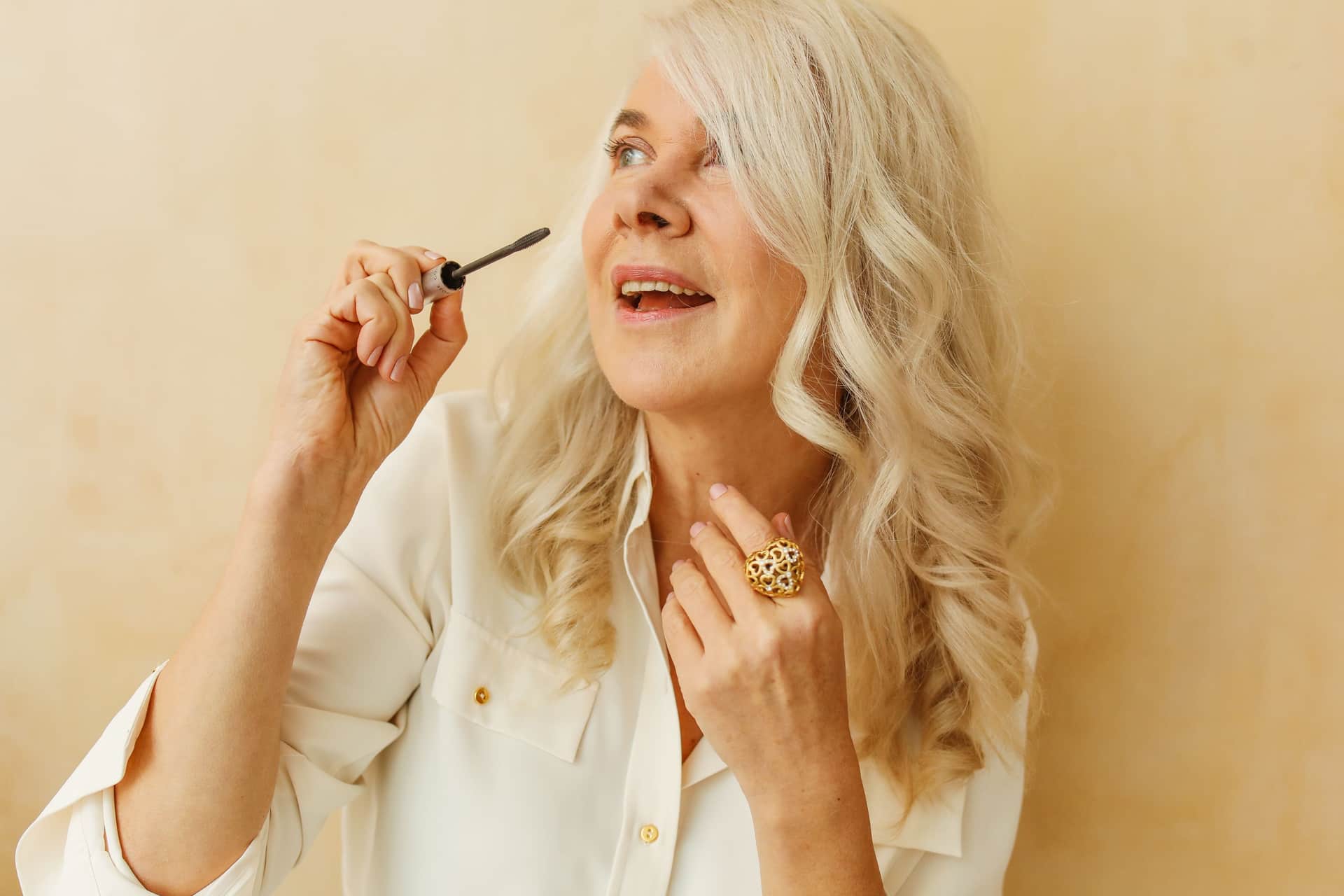
Three things change around the eye after 50 and they change independently, which is why advice written for a younger eye lands so badly. The lid relaxes and becomes hooded, so the surface you are drawing on folds over itself when your eyes are open. Lashes thin and lighten, so there are fewer of them holding less product. And brow hairs go sparse and often wiry, so a shape that worked for thirty years stops reading as a brow.
This page is about the sequence rather than about any one product. The site already has a page for each individual choice — the mascara, the liner, the shadow, the brow pencil, each by concern. What none of them can carry is the thing that actually decides how a mature eye looks at the end: the order you do it in, and the fact that four of the five steps are mostly about keeping product off the places it wants to migrate to.
Why the order matters more than usual here. On a hooded lid, the crease touches the lash line when the eye is open, which means anything applied to the lid transfers upward and anything applied to the lash line gets pressed into the fold. Every step below is positioned to work with that rather than against it: the base goes on to stop migration, the color goes on as a cream because cream does not dust into a crease, the liner goes as close to the lash base as you can get it because a line drawn higher disappears, the mascara goes on as a tube rather than a wax coat because wax flakes into the crease, and the brows go last because a brow is drawn to balance the eye you ended up with rather than the one you started with.
One honest point about how much of this you need. Five steps is the full version and a lot of people over 60 look better doing three of them. Base, mascara and brow is a complete eye. Shadow and liner are the two that add the most and go wrong the fastest, and skipping them is a legitimate choice rather than a compromise — how much makeup should a 70 year old woman wear takes that question seriously.
What we looked for in the picks. A format that resists collecting in a crease, because that is the dominant failure mode in this whole category. A removal method that does not require rubbing, because the skin here is the thinnest on the face and rubbing it is worse than any makeup you could put on it. Enough pigment to read at a conversational distance without needing a heavy hand. And a container or applicator you can actually use — a slim wand held in mid-air is a hard ask for an unsteady hand, and almost nobody in this category mentions it.
What we are not claiming. We have not tested these products, worn them through a day, photographed wear or run a panel. Formats, finishes and formula facts come from the manufacturers' and retailers' own listings; the reasoning about hooded lids, migration and sequence is ours and is presented as reasoning. All five products were already in this site's registry and each was confirmed on sale when it was added.