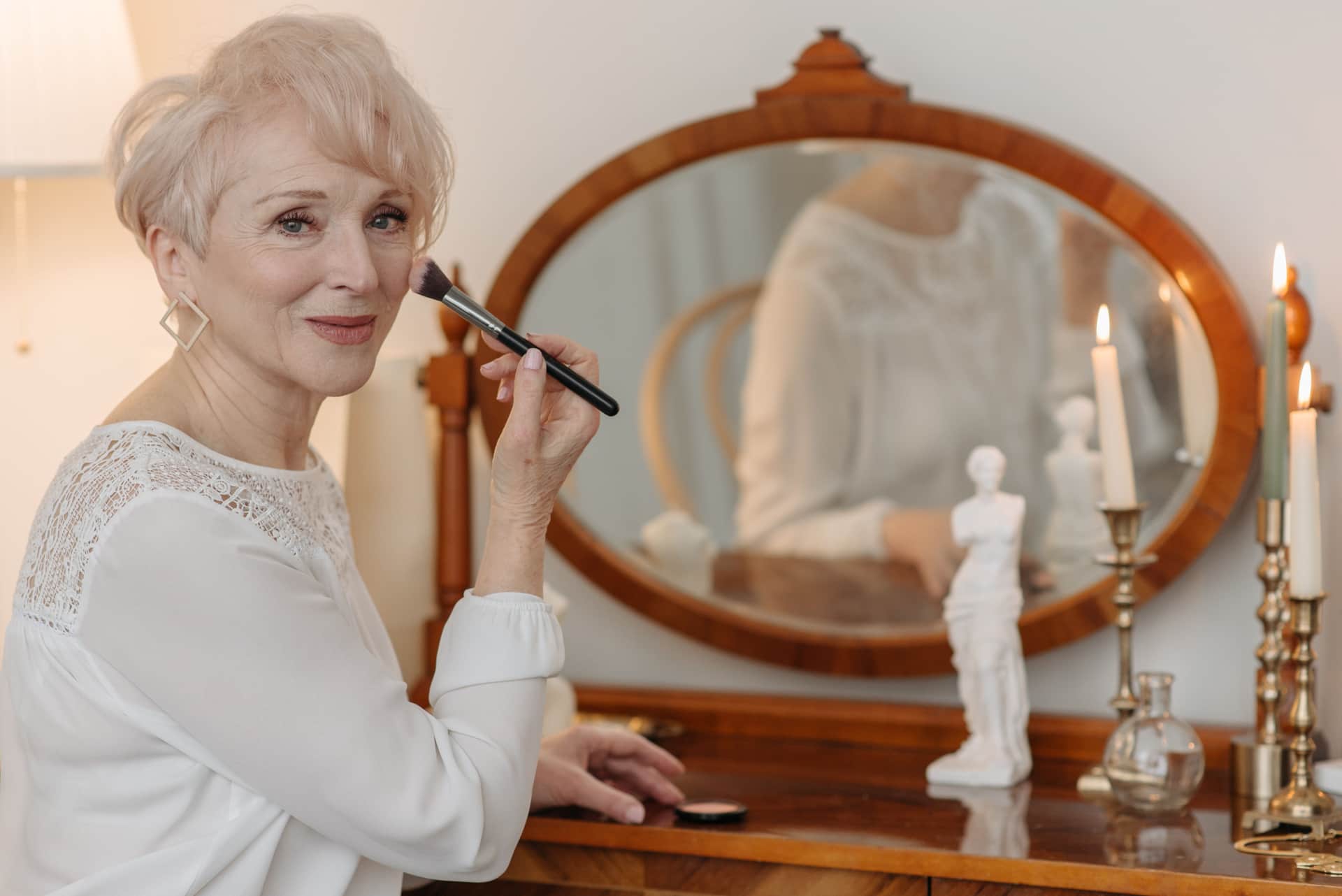
A tremor changes which makeup techniques are available, and most makeup advice responds to that by suggesting practice. That is the wrong intervention. A tremor is not a skill deficit, and the useful responses are mechanical — changing what supports your hand, and changing which products require precision in the first place.
Bracing is the first and largest. A hand held in mid-air has nothing damping its movement. A hand resting on a solid surface, with a finger touching the face, has two points of contact and the movement available to the tool drops dramatically. Sitting at a table with your elbow on it and your little finger on your cheekbone is free, takes no practice, and changes what is possible more than any product.
The commercial version of the same idea exists, and it is worth knowing about: applicator handles designed with an enlarged rim and a finger rest, shaped to brace against the face so the tool carries its own weight rather than being held steady in the air. GUIDE Beauty builds its whole range on this, founded by a makeup artist who lost dexterity to Parkinson's and worked with product designers on the problem. Whether or not you buy the products, the principle is the useful part.
The second principle is choosing forgiving products. Some makeup demands precision by nature and some does not, and the difference is large. A brow pencil asks you to draw individual hairs; a brow gel asks for one stroke in roughly the right direction. A liquid liner asks for one accurate continuous motion; a pencil smudged into a shadow asks for approximate placement. A powder shadow palette asks for controlled blending; a cream shadow stick asks you to draw on the lid and smudge it. In each pair the second option is both easier and, on a mature face, usually more flattering.
And the third is reducing the number of attempts. Every product that needs two coats, two steps or a correction is more opportunity for a shake to matter. Four products, one coat each, is the routine that works.